
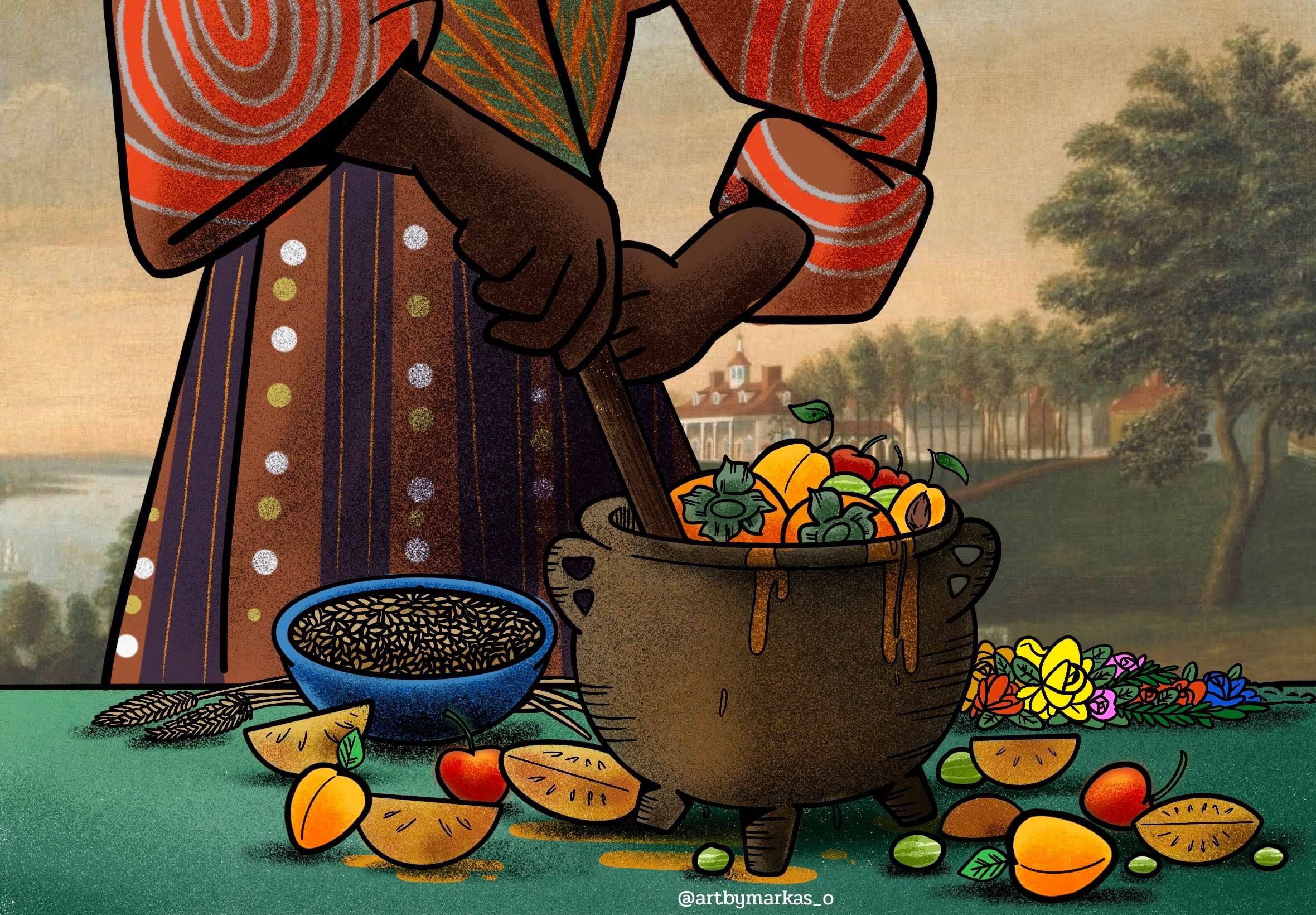
"The kitchen was Doll's domain."— Jessie MacLeod, Associate Curator, George Washington's Mount Vernon
A Woman at the Center
Doll was thirty-eight years old when she arrived at Mount Vernon in 1759—among the more than 80 enslaved people Martha Dandridge Custis brought to her marriage to George Washington.
Forced to leave her home in New Kent County, Virginia, Doll arrived at a new plantation and a new community. She brought with her an expertise that would define the estate's kitchen for decades to come.
As cook for many years, she worked long hours preparing hoecakes, smoked hams, and other Washington family favorites. Mount Vernon's constant stream of visitors meant she regularly produced large, elaborate meals. She worked closely with Martha to plan each day's menu and monitor ingredients—but the kitchen was her domain.
She passed her expertise to her daughter Lucy, who succeeded her as one of the estate's cooks. In her later years, Doll continued using the kitchen to distill rose and mint water for medicinal purposes and to dry fruits such as cherries—practices that passed through the generations.
The Garden's Memory
Recent archaeological discoveries beneath Mount Vernon's mansion house—currants, gooseberries, cherries—echo Martha Washington's own words: "Old Doll" knew how to preserve gooseberries for the family's return.
The knowledge was Doll's. The craft was Doll's. It is from this preserved knowledge—this quiet mastery—that Doll's Garden takes its name, and its persimmon.
A Family That Endured
Doll was the matriarch of one of the largest extended families within Mount Vernon's enslaved community. By 1799 she had five children, fourteen grandchildren, and at least four great-grandchildren living on the estate.
Her daughter Lucy married Frank Lee, the enslaved butler. Her grandson Christopher Sheels became Washington's personal valet. Because she was Custis property, Doll remained enslaved after Martha Washington's death. By 1802 she would have been eighty-one years old.
Learn More About Doll
- Doll — Full Encyclopedia EntryGeorge Washington's Mount Vernon · Written by Jessie MacLeod ↗
- Old Doll — Video DocumentaryMount Vernon · YouTube ↗